Western University · Mechanical & Materials Engineering
Additive Manufacturing for Sustainable Materials Laboratory
Low-Carbon · Renewable · Circular
About Our Research
The Additive Manufacturing for Sustainable Materials (AMSM) Laboratory focuses on advancing sustainable materials through additive manufacturing. Our research explores how additive manufacturing processes can be used not only to shape materials, but also to engineer their internal structures and properties across multiple scales during fabrication.
We develop advanced additive manufacturing technologies and processing strategies, integrating feedstock engineering, process control, and materials characterization to establish processing–structure–performance relationships.
Our current research focuses on three sustainable material systems: low-carbon functional materials, renewable-fiber composites, and recycled polymers, with applications in carbon capture, lightweight structures, and circular manufacturing.
Principal Investigator
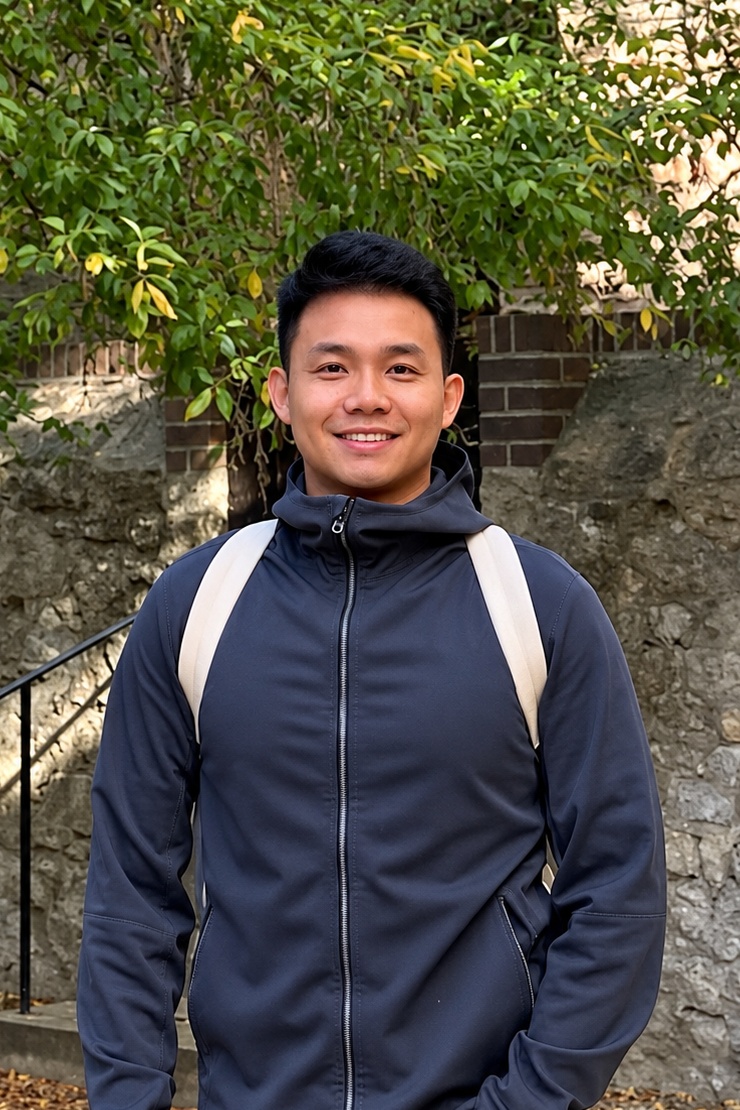
Chao Xu, Ph.D.
Incoming Assistant Professor Department of Mechanical & Materials Engineering Western University · January 2027
Dr. Xu develops advanced material extrusion technologies, including pore-forming, rotational, and field-assisted direct ink writing for multiscale materials engineering.
Research
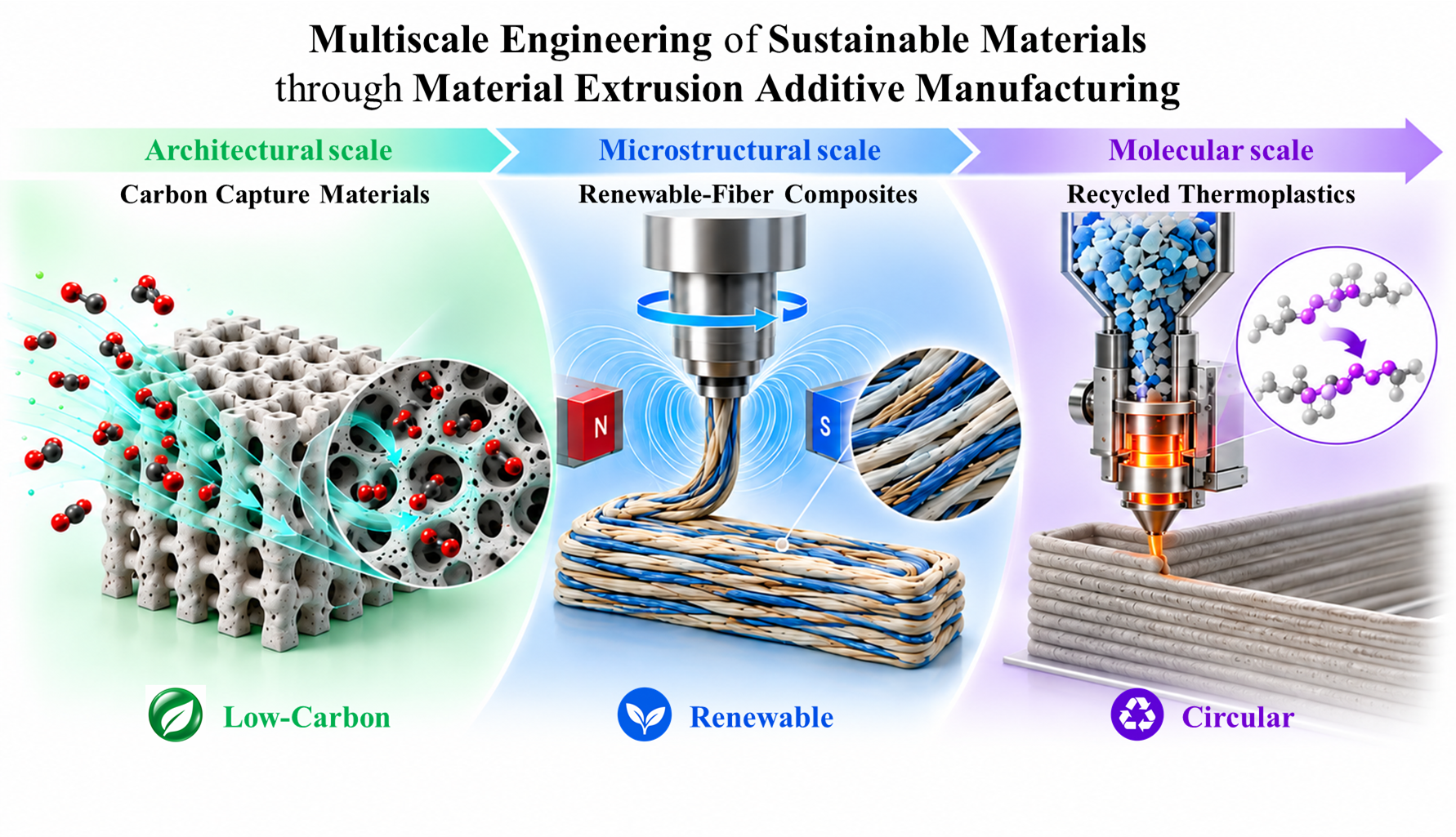
Multiscale Engineering of Sustainable Materials through Material Extrusion Additive Manufacturing.
Current Research
Low-Carbon Functional Materials
Architectural Scale
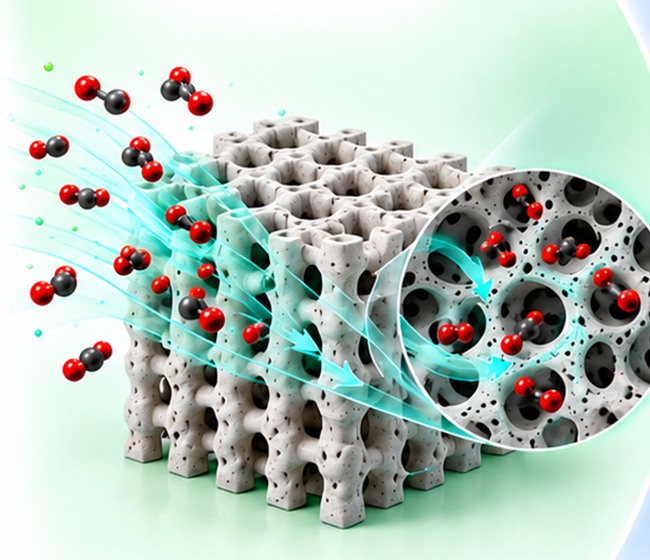
We investigate additively manufactured low-carbon geopolymer–zeolite adsorbents for CO₂ capture. Using direct ink writing (DIW), particularly rotational direct ink writing (RDIW), we aim to engineer pore orientation and connectivity within printed filaments while maintaining larger flow channels. Our research explores how pore architecture influences gas transport, dynamic CO₂ adsorption, and mechanical integrity.
Renewable-Fiber Composites
Microstructural Scale
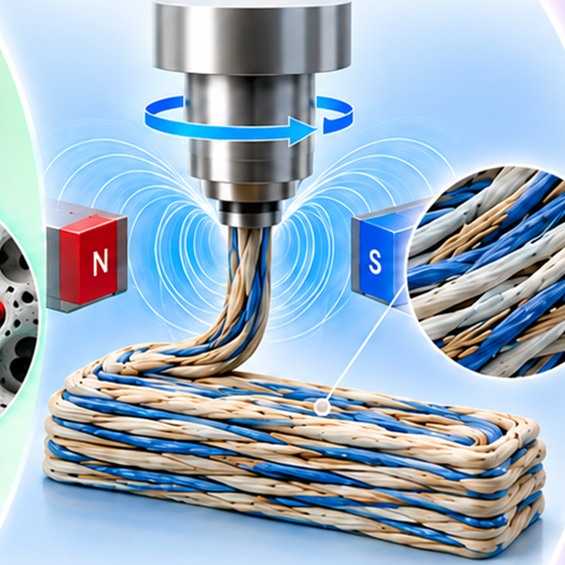
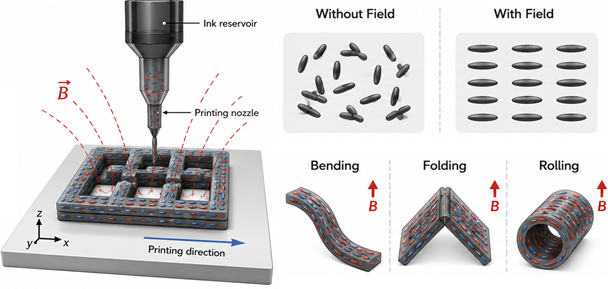
We develop magnetic-field-assisted DIW strategies to control the orientation and deformation of flexible renewable fibers during printing. By understanding the interplay between magnetic fields, extrusion flow, and fiber behavior, we aim to engineer location-specific reinforcement and improve composite performance under multidirectional loading.
Recycled Polymers
Molecular Scale
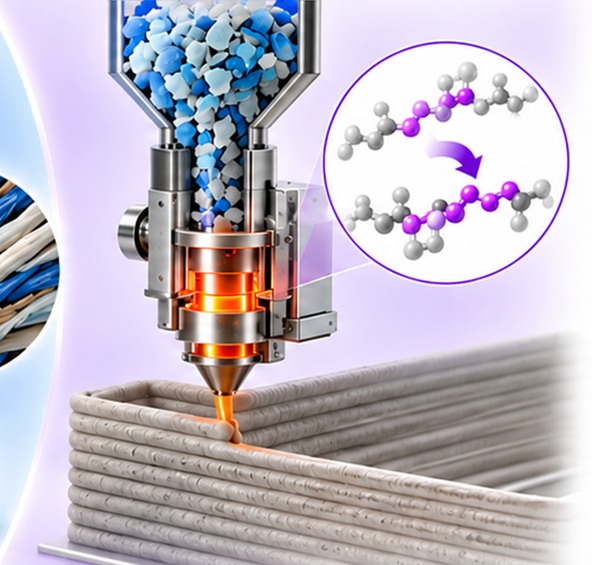
We investigate in-situ polymer chain repair during fused granulate fabrication (FGF) of recycled thermoplastics, including recycled polyethylene terephthalate (PET). By integrating chain extension into the final melt-extrusion stage, we aim to restore polymer processability and mechanical performance while reducing unnecessary additional melt-processing steps.
Selected Research Contributions
Pore-Forming Direct Ink Writing
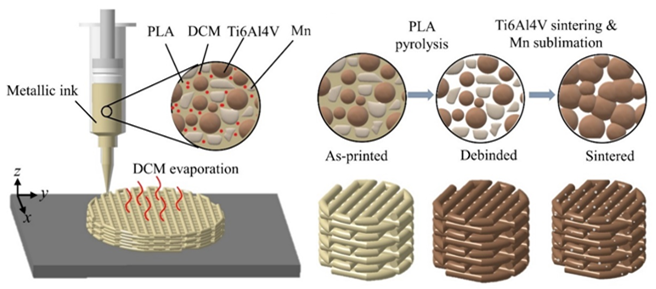
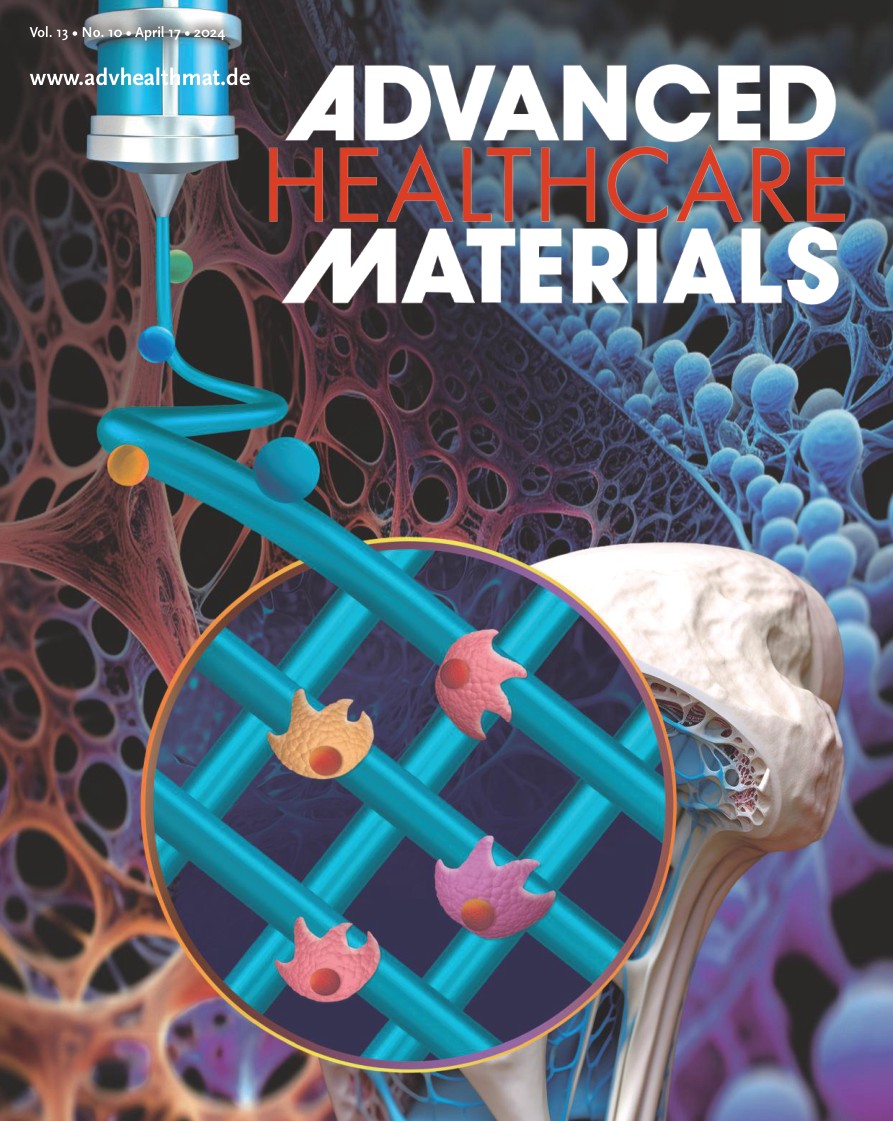
We developed pore-forming DIW to fabricate hierarchical porous structures by introducing sacrificial particles to create tunable intra-filament pores independently of designed structural pores. This approach has been demonstrated in 3D-printed metallic bone implants.
We developed magnetic-field-assisted DIW to spatially program magnetic particle orientation and magnetic moment distributions during printing. This method enables multimodal actuation in 3D-printed soft structures.
We developed RDIW to organize materials within printed filaments through controlled nozzle rotation, enabling programmable helical and multimaterial architectures. This approach has been demonstrated in bioinspired structural materials.
We developed DIW-based strategies that combine magnetic programming, energy storage, and responsive polymer materials to control actuation and shape locking. These strategies enable programmable motion and adaptive soft robots.
Dr. Chao Xu is an incoming Assistant Professor in the Department of Mechanical & Materials Engineering at Western University, starting in January 2027.
His research focuses on advanced additive manufacturing and materials engineering, with particular expertise in material extrusion (MEX) technologies. He has developed customized additive manufacturing systems and processing strategies, including pore-forming direct ink writing, rotational direct ink writing, and field-assisted printing, to control material composition, architecture, microstructure, and properties across multiple scales.
His research has enabled advances in additively manufactured functional materials and structures, with applications in biomedical implants, programmable soft robotics, smart materials, and multimaterial systems. His broader research experience also includes metal additive manufacturing and functional metallic structures.
At Western University, he will establish the Additive Manufacturing for Sustainable Materials (AMSM) Laboratory, focusing on the multiscale engineering of low-carbon, renewable, and recycled materials through advanced additive manufacturing.
Education
2018Ph.D. in Mechanical Engineering Polytechnique Montréal, Canada
2014B.Eng. in Mechanical Engineering Jilin University, China
Academic Appointments
2027–Incoming Assistant Professor Western University, Canada
2019–2026Professor / Associate Professor / Assistant Professor Jilin University, China
2025Visiting Scholar University of Oxford, UK
2019Postdoctoral Fellow McGill University, Canada
Selected Honors & Awards
2025CAST Youth Talent Award China Association for Science and Technology
2024Tang Aoqing Distinguished Scholar Jilin University
Publications
Journal publications in additive manufacturing, materials engineering, and functional structures.
Research Highlights
Selected publications showcasing material extrusion technologies, programmable materials, and multiscale structures.
† Equal contribution (co-first author) * Corresponding author. Authorship symbols are shown where confirmed from the publication or an institutional author list.
All Journal Publications
33 peer-reviewed journal articles (2017–2026), organized by publication year.
Journal of Materials Chemistry C, 5(40), 10448–10455 (2017) · DOI ↗
† Equal contribution (co-first author) * Corresponding author. Symbols are shown only where a published author note or institutional publication list identifies the role.
Opportunities
Prospective PhD Students
The AMSM Lab welcomes prospective PhD students with backgrounds in mechanical engineering, materials science and engineering, chemical engineering, polymer engineering, or related disciplines. Research opportunities focus on low-carbon functional materials, renewable-fiber composites, and recycled polymers through material extrusion (MEX) additive manufacturing.
Experience in one or more of the following areas is particularly welcome:
MEX additive manufacturing, particularly direct ink writing (DIW) and fused granulate fabrication (FGF).
Polymer processing, rheology, and composite materials, including feedstock formulation, extrusion, and fiber reinforcement.
Materials processing and characterization, including microstructure and processing–structure–property relationships.
Applicants do not need experience in every area. Candidates with strong research potential and relevant technical backgrounds are encouraged to apply.
How to Apply
Please email your CV, academic transcripts, and a brief description of your research interests and relevant experience to chao.xu.me@gmail.com.
Formal admission is subject to Western University's graduate admission requirements. Available positions and funding will be discussed with prospective candidates.
Contact
Chao Xu, Ph.D.
Department of Mechanical & Materials Engineering
Spencer Engineering Building
Western University
London, Ontario, Canada N6A 5B9